





Imagination is quite possibly a uniquely human ability.
It is considered as such because it involves thinking about possibilities. In essence, it allows us to explore ideas of things that are not in our present environment, or perhaps not even real. (Wikipedia).
Another word for imagination is creativity. Some people are wildly creative and some people are confined by only what they see or know around them. The second set are interested in rules and facts as the starting point for their actions.
Children are, by nature, creative. They are imagining all day long. They rehearse experiences and join together ideas in a fluid stream as each new piece of information reaches them.
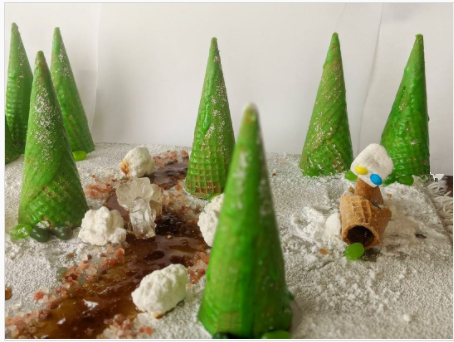 Food landscape Age 7 with tobogganer
I was looking at my grandchildren who are “wildly creative” as they dismantled the TV room
and set up a “house” with kitchen chairs as walls and blankets draped over the top, sofa cushions, rope string, cellophane tape, dolls, vehicles, a shaggy baby blanket for the floor and dishes for serving pretend food. My daughter encourages them to do all this by not minding if an explosion of activity is centered in the house. She goes way beyond it with art projects at every turn. Painting up one arm and down the other has been a frequent pastime. I must confess, I have encouraged such messes with my own children. It is important to understand in a deeper sense what they are doing. They are learning by imagining and making connections.
To me, the best idea when talking about a subject to look up the definition and here it is: Imagination is the ability to produce and simulate novel objects, sensations, and ideas in the mind without any immediate input of the senses.
It is also described as the forming of experiences in one's mind, which can be re-creations of past experiences such as vivid memories with imagined changes. Imagination helps make knowledge applicable in solving problems and is fundamental to integrating experience and the learning process. A basic training for imagination is listening to storytelling, (all of this says Wikipedia).
Everyone seems to quote Albert Einstein on the subject who seems to have become the Guru of thought on so many subjects and so I looked that up too. He said a lot more and you can read quite a lot from him if you get start down that path.
Albert Einstein said, "Imagination ... is more important than knowledge. Knowledge is limited. Imagination encircles the world."[15]
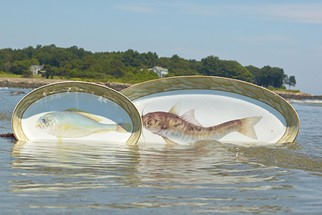 We tried this flow. It wasn’t great.
Famed psychologist, Mihaly Csikszentmihalyi, who first identified the mental state of flow, wrote the book “Creativity: Flow and the Psychology of Discovery and Invention.” Kacey Spencer tells us. She goes on in an article, “A leading theorist in the positive mental state, he describes creativity as, “a central source of meaning in our lives … most of the things that are interesting, important, and human are the results of creativity … [and] when we are involved in it, we feel that we are living more fully than during the rest of life.” Based on the previous definition, creativity invokes both the artistic and the analytical. It takes creativity to not only create music but to develop the technology and device to play it. Can we conclude that anyone, anywhere can be creative? The answer is yes. Much like the tools used to create, creative thinkers come in all forms. It is not just a trait you are borne with, “says Katie.
OK, now I was getting into trouble because I do not want to say that I know anything broad-reaching about this subject and it is not clear to me why one would be reading this blog. Here we are not talking about products or history or design as such, but the broader subject is “what makes for great imagination”. I got his book and tried to boil down his ideas. He, being a university professor, decided to use the scientific method and culled a list of people in several different fields who were considered the best, brightest and most creative in whatever field they were in. They were interviewed and the researchers compared notes.
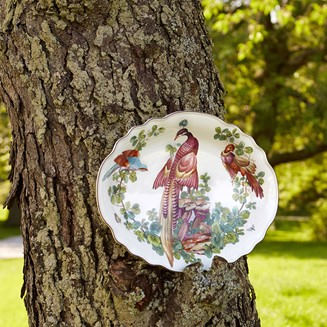 Well, Better?

Paul Wojcik and New Growth Permanent Florals with our tulipiers.
Don’t forget fun. Creative people get it.
The primary thing all of them had in common, (we will call him Mihaly) says, is that they loved what they did and considered it an opportunity to enjoy the work because it was fun. They were dedicated their field whether it made money or not because it gave them meaning and they enjoyed it.
They were motivated by an intense curiosity which gave them broad knowledge of a field and this allowed them to be able to judge if an idea or plan was good and workable. They were inventive and would make do with whatever was at hand. They felt they had limited time and therefore concentrated intensely on their field of endeavor. It seems that these creative people have a tremendous amount of confidence and this might stem from being given the freedom to explore, even if it takes them down a dead end, because they learn from everything.
Logical thought, knowledge and spirituality: a central source of meaning in our lives …
We know where logical thought can take us and the same with knowledge, but what role does spirituality have to do with it? Faith is a belief in the unseen, and for many people this is religion or God. The definition of God we use here is the unknowable essence that animates the universe. We know certain things exist because there is evidence of them, such as gravity. We know not to step off a roof or what will happen when we throw a ball. There is no question about gravity however much we can’t see it, we can see its effects.
The nature of inspiration: Being open to a subject. Being open to an answer.
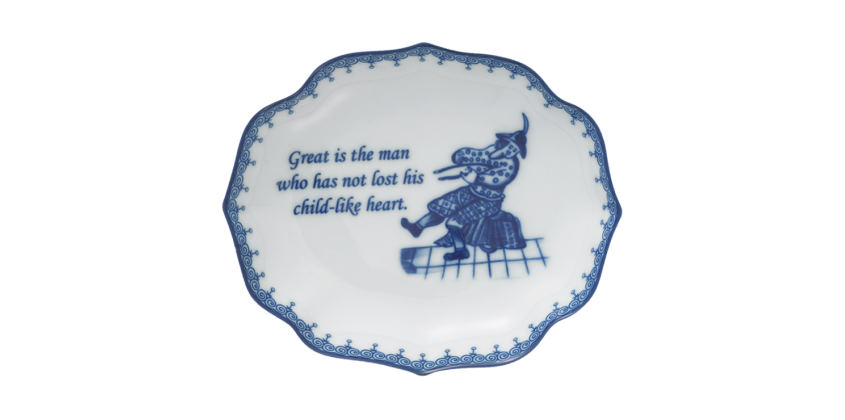
But in this instance, spirituality is used in the context of inspiration. If you meditate upon an idea and focus your mind on it, you will become informed about a subject or if not informed, you will search for the answer. This is the nature of inspiration: being open to a subject, being open to an answer and being impelled to create or envision something new, something good. Inspiring ideas are not created by us, they are discovered by us, as a reflection of this unseen world. Creative people are willing to see beyond what is evident in the knowledge that the possibility exists. This is for all fields, not just the visual arts. We leave you with this saying on one of our verse trays and wish you a childish heart.