






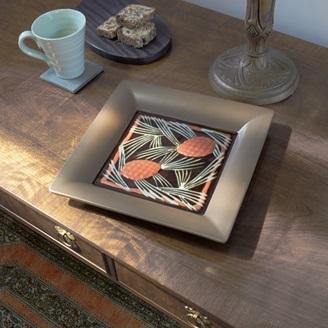
Mottahedeh has partnered with Rookwood Art Pottery to introduce vintage and classic vessels that reflect the rich history of Rookwood, one of America’s most honored decorative arts companies. Founded in Cincinnati in 1880 by Maria Longworth Nichols, Rookwood Pottery was the first female owned manufacturing company in the United States. Mottahedeh is know for its antique reproductions in porcelain, licensed by several American museums. Behind every Mottahedeh piece is a story,” Mottahedeh President Wendy Kvalheim says.
American Art Pottery refers to aesthetically distinctive hand-made ceramics
American Art Pottery refers to aesthetically distinctive hand-made ceramics
in earthenware and stoneware from the period 1870-1950s. Ranging from tall vases to tiles, the work features original designs, simplified shapes, and experimental glazes and painting techniques.
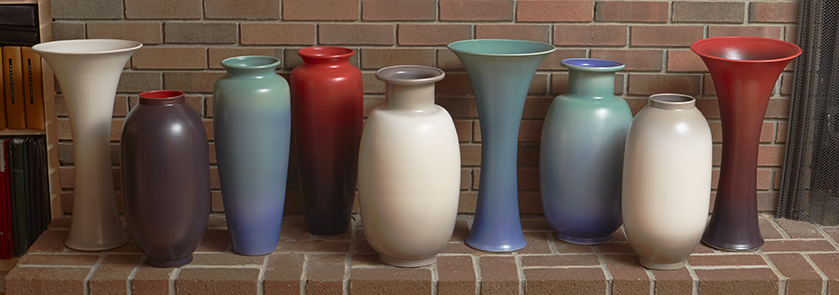
“Having a love for the simple styles and rich vellum type glazes that characterize this time period America, I was excited to learn that Rookwood had been brought back to life by avid art lover Marilyn Scripps. She is an entrepreneur who understands the cultural and architectural heritage of Rookwood’s Arts and Crafts pottery period and has assembled artisans from across the United States to make this vision possible. When I approached Rookwood with the idea of making vessels that would be substantial and also reflect Rookwood’s history, they embraced our collaboration. We have developed this assortment together. “
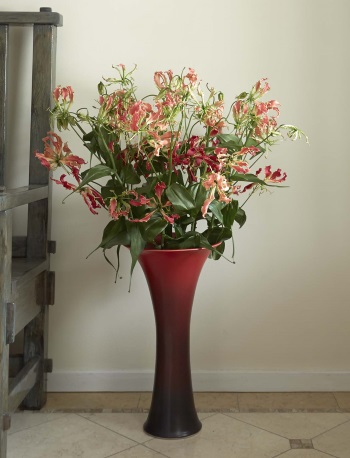
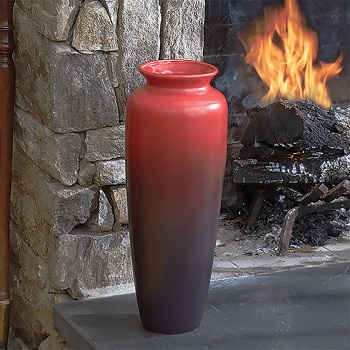
In the basement of their new production facility was an old fashioned safe and they discovered locked inside was a glaze formula book with recipes for countless early glazes. These have been used to create the glazes on our vessels. Rookwood is known for sophisticated gradient glazes. and we have taken a simplified version of these for a contemporary yet classic, and casual yet elegant look.
Rookwood today is located in its home town of Cincinnati, Ohio.
Rookwood today is located in its home town of Cincinnati, Ohio. Art pottery was made by some 200 studios and small factories across the country, with especially strong centers of production in Ohio (the Cowan, Lonhuda, Owens, Roseville, Rookwood, and Weller potteries) and Massachusetts (the Dedham, Grueby, Marblehead, and Paul Revere potteries). Most of the potteries were forced out of business by the economic pressures of competition from commercial mass-production companies as well as the advent of World War I, followed a decade later by the Great Depression. But the style and influence continued on.
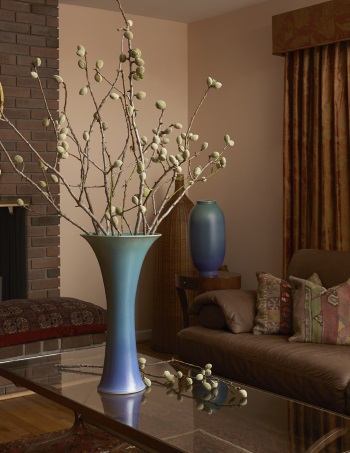
Rookwood was particularly skilled at painting of the surface of the glazed ware a there are so many outstanding one-of-a-kind vases and bowls today. Our Mottahedeh pieces are deceptively simple with an all over glaze that moves from light to dark in an ombre effect.
Every work of art or craft is a reflection of the mind and feeling of an individual.
Every work of art or craft is a reflection of the mind and feeling of an individual. There is always something that drives that person to make an expression. His/Her own point of view leads to innovation, and something happens with people collectively where they get behind that idea to make it a reality. This is the value of artistic expression. It can only happen if people are free to make those expressions. Or they are courageous enough to express themselves in the face of doubt. The American Arts and Craft Pottery movement blossomed in an ever-increasing circle of individuals, aided by business people into an economic enterprise and style that has won a place in time. We hope the work that Rookwood is developing will bear fruit for a long time to come.

Today’s Top 10 List of the ten most influential arts and crafts pottery makers
Learn more about this time period in American Art.
To help you along here are today’s Top 10 List of the ten most influential arts and crafts pottery makers, according to Greg Myroth – Just Art Pottery are listed below with his assessment. It is a good read. The Cincinnati Art Museum has a wonderful collection of art pottery in a full wing of its own and Rookwood has a place of pride there. “We do consider Rookwood to be the best, I have to admit that I also have a fondness for Roseville Pinecone series.” Blue greens and salmon predominate in that color palette.
- Grueby – It is fairly easy to make the argument that Grueby was the most important producer of arts and crafts pottery in American history. Grueby’s organic matte green has been copied from the beginning days of the Arts and Crafts Movement and remains the standard to which many contemporary potters strive. Notable imitators of the Grueby Potterymatte green glaze were Hampshire, Wheatley, Merrimac, Teco, Rookwood, and the Zanesville area potteries.
- Newcomb College– The arts and crafts pottery produced by Newcomb College has been a favorite of pottery collectors for many years. Newcomb was a true arts and crafts pottery where each vase was hand-thrown and hand-decorated. Flowers, landscapes, and bayou scenes are the predominant designs on Newcomb Pottery vases.
- Rookwood– One could easily make the case that Rookwood produced the highest quality American art pottery. Rookwood’s production standards and quality control were second to none. Often what is considered average quality for Rookwood Pottery would be considered exceptional for Roseville, Weller and other makers. Throughout history, Rookwood easily embraced and excelled at producing art pottery consistent with the Art Nouveau and Arts and Crafts Movements. The primary Arts and Crafts lines produced by Rookwood are the hand carved and painted matte lines.
- Teco– Teco’s matte green pottery has set the standard for the Prairie School branch of the Arts and Crafts Movement. Teco’s geometric and architectural vases are the perfect compliment to Frank Lloyd Wright and Prairie or Mission style homes. Unlike Grueby and Newcomb College, Teco pottery was primarily molded rather than handcrafted.
- George Ohr– George Ohr is considered by many art pottery enthusiasts to be the most significant potter in American history. George Ohr pottery has increased significantly in value over the last several years with better Ohr vases selling in the low six figure range. George Ohr reproductions and reglazing of bisque vases and bowls has become increasingly prevalent in today’s art pottery market.
- Marblehead– The simple forms and pleasing matte glazes make Marblehead pottery an ideal decorative addition to Arts and Crafts interiors. Decorated Marblehead vases are highly sought after by collectors. At one point, a 7" Marblehead vase with stylized flowers held the record price for arts and crafts pottery sold at auction. Even Marblehead’s production pottery was of high quality. Marblehead was truly a small studio pottery typically employing only a half-dozen or so workers.
- Van Briggle– Greg Myroth’s personal favorite, Van Briggle produced some of the best arts and crafts pottery around. Consistent with the Arts and Crafts Movement, Van Briggle utilized organic designs and natural earth tone colors. Similar to other American art pottery makers, quality at Van Briggle deteriorated after 1915. However, it is still possible to find quality arts and crafts style vases produced in the 1920s period.
- Weller– The early, hand-decorated pottery vases produced by Weller compare very favorably with that produced by Roseville. While Frederick Rhead was the leader at Roseville, Weller Pottery was blessed with the services of Jacques Sicard who developed the Sicard line. Other notable Weller designers and decorators include Frank Ferrell, Levi Burgess, Frederick Rhead, Hester Pillsbury and many others.
- Roseville– Roseville pottery has the largest collector base of any American art pottery maker. The most recognized hand crafted, arts and crafts Roseville pottery includes Della Robbia introduced by Frederick Rhead and Fujiyama created by Gazo Fujiyama (Fudji). Frank Ferrell is another recognized Roseville designer.
- Saturday Evening Girls (SEG)– The story behind the Saturday Evening Girls Club is almost as interesting as the arts and crafts pottery and certainly adds to its charm. Handcrafted SEG pottery was often decorated with farm animals or simple landscape scenes.