






Purity of Body
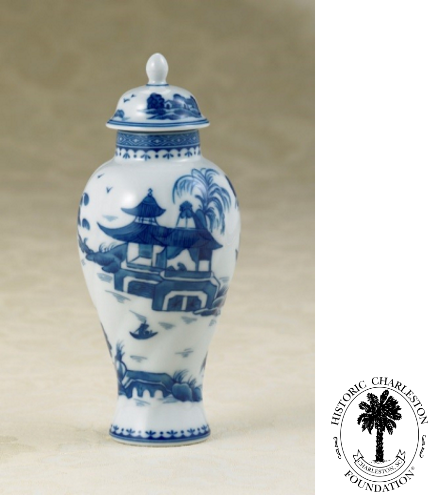
Porcelain is a specific type of ceramic material. The necessary ingredient that differentiates porcelain from other ceramics is a naturally occurring ore called Kaolin. It is a pure white powdery substance that is actually decomposed granite. It enables ceramics to be fired at an incredibly high temperature that fuses the clay into a durable solid.
Just like a great piece of fine crystal, porcelain should be free of impurities such as bubbles or spots on the plate or crazing of the glaze.
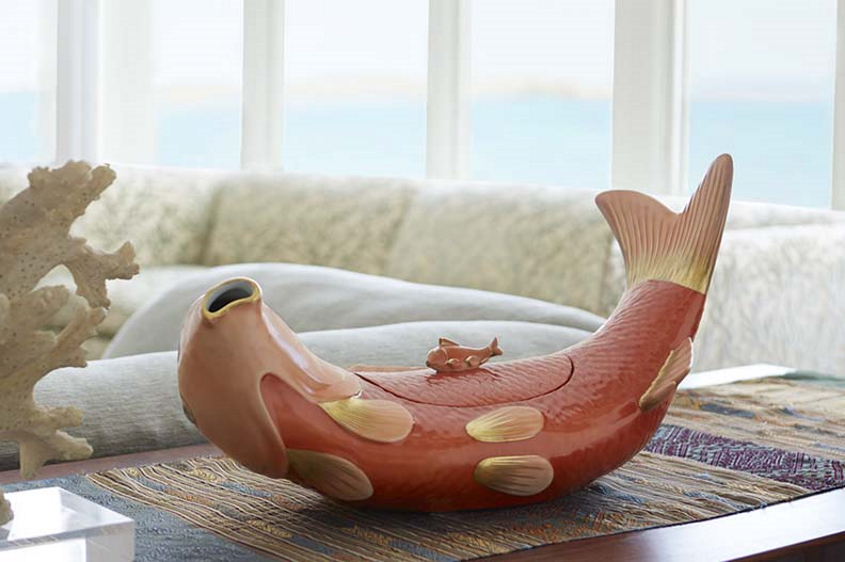
Porcelain is commonly known in two forms: Hard Porcelain and Bone China. Mottahedeh makes hard porcelain and softer ceramics such as faience.
Hard porcelain becomes non-porous when it is baked and is fused solid so that its strength is enhanced, but it tends to slump in the kiln at the point when the clay is vitrified (turns into glass). The English invented Bone China by adding 40% bone ash into the clay so that it would not sag in the kiln. It also made it possible to fire at a lower temperature. Bone china can be shaped more thinly but the fired result is porous and requires a glaze over the surface to seal it from liquid
Light and Complex Shape
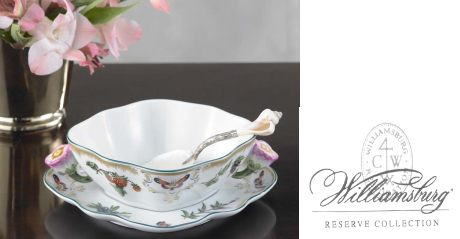
It has become increasingly difficult to make the complex type of wares that were fashionable in past centuries because porcelains were made in small batches before the industrial revolution. Today, factories use mechanized production and are interested in making the simplest type of plates in large qualities with little human contact. Thus, the plates are relatively flat and uniformly circular. The range of shape choices is narrow.
It is also a reality that the art of ceramic making is developed over time and the best porcelain is produced in cultures with a long history of making it, allowing for mastery of techniques that are passed down to generations. While it is an industrial process, it is a little like baking a cake, the principles are the same, but you need to tweet it each time, depending on the type of flour, what you used for sugar and how much liquid is the right amount. Clay, which is mined from the ground and combines with other ore such as kaolin, feldspar and quartz, vary from place to place. In the 1700 and 1800’s wares from China had a high level of iron oxide that gave the body a gray appearance. We still use this type of body today, in order to give our designs an authentic appearance.
Brilliance of Color and Definitive Style
As we previously wrote:
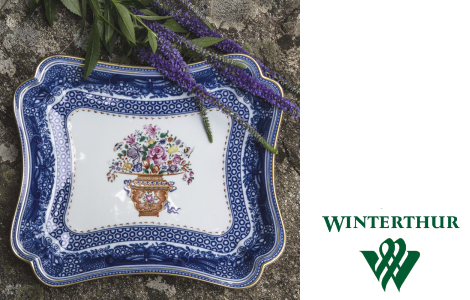
How do we get those colors on a plate, you ask? It is not that easy. We make a silk screen of the design and each screen is a color. People in the industry aim for a maximum of 8 colors and only a few companies have the know-how to print more because the colors are made with oxides or earth such as iron, copper, sulphur, cobalt, etc., rather than paint. They melt when they get to very high temperatures (like over 2000 degrees fahreinheit). The expertise neede to get the colors all to melt at the same time, maintain their desired hue, fuse smoothly into the clear glaze of the plate without reacting with each other is quite sophisticated. The more colors, the more complicated it becomes.
Hard porcelain fires at a higher temperature than other ceramics and the oxide fuse into the body of the plate. So hard porcelain is dishwasher proof and resists scratching. It resists chipping and breaking.
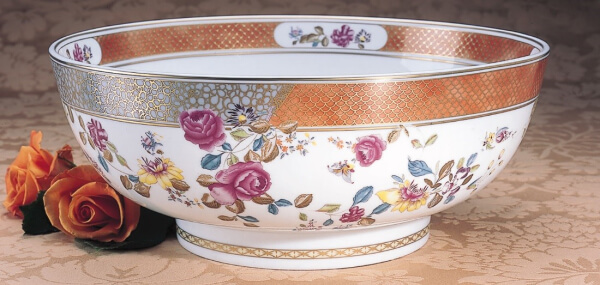
This large presentation bowl looks rather historic but it is actually a new creation (not so new to us). The design is an adaptation using our Lowestoft Rose dinner service made in 1775, and the design of a bowl we saw in an antiques catalog. These colors are typical of this style in that period called Famille Rose, with the use of Magentas, gray and yellow and a abundant use of gold.