






Remember the "Mottahedeh Memo" post I had been talking about a week or so ago? Well, here we are ready to kick-start a short series of "how-to's". Refresh your memory by first clicking on this link here - CLICK.
If you ask a child to set the table before they've been exposed to table manners you'll probably get a pile of cutlery, a stack of plates, and maybe a napkin here or there. This is completely fine for buffet style meals or BBQs, but maybe not so much for a more formal dining experience.
Dining etiquette is not just for adults! If we expose our children to proper table manners from a young age - they're more likely to behave appropriately at restaurants and parties. And as they get older, eating in more established or formal settings will feel natural instead of uncomfortable and foreign. I personally believe that regardless of social income, race, gender, religion, or ethnicity the more exposure we have to the world, the more comfortable we'll feel in different environments and situations - and likewise we'll be able to relate to more people. One of the first ways to expose children to table manners is by example. But how do you show by example if you're not even sure for yourself?! "THERE'S NO NEED TO FEAR! MOTTAHEDEH MEMO IS HERE!"
Okay maybe it's not that serious (and Underdog doesn't need to help us out in this situation; after all, he is a super hero from the '60s and not a dining connoisseur.)
But before we even really get into table etiquette, let's start with setting a table.
First and foremost, unless you're planning on having people sit on the floor, it'd probably be a good idea to have some form of a table and chairs.
"Think of your dinner table as a presentation. When people see your table set before they sit down, they feel a little bit special because they realize that, no matter how simple the table, you took care and thought into serving them."
Each seating arrangement should be about 2 and a half feet wide. This gives a person enough room to sit comfortably and enough elbow room not to bump into the person next to you. No one likes getting their meal flung across the table in a battle of the elbows. (When we were younger my bother and I, every night, would have this battle. At the time he was much smaller than me - so I'd always win. I have a little bit of a mischievous streak in my personality and I've been known to instigate playful roughhousing. However, these days, when we get together for family meals - 10 out of 10 times I lose. And if I'm anywhere near winning, my husband will step in and assist my baby brother - who, might I add, definitely doesn't need the help.) But having the space, when you're not with people you can roughhouse with, is much appreciated and makes for a more comfortable dining experience.
Table cloth -vs- place mats -vs- a bare table:
First of all - how's the table? Is it a nice surface, or is it cracked with water glass rings on it? It could be a simple card table or a door with some legs. All that really matters is that it's stable. Just yesterday I was sitting with a friend at a table that flips sideways for storage. When it is in use there's a latch to hold it flat. Somehow the latch had been dislodged. We nearly sent our lunch flying into the wall. Luckily we caught it just in time - but in telling you this, all I mean to say is make sure your table is stable; all latches are lodged, and all legs are screwed on tight...
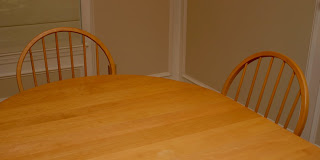 With this beginning point, you can now decide how you want to treat your table. The most formal presentation is a table cloth, but it doesn't have to be formal in style. The nice thing about a table cloth is it hides all surface sins! You can get creative by using a sheet with a nice pattern on it, or buy a few feet of fabric and sew the edges to make a table square. Plenty of places sell beautiful and casual table clothes. A cotton shawl turned on the diagonal can be beautiful - but if you use one, make sure it's something you're not attached to. People may spill or make stains on it. The most elegant table clothes are made of silk embroidery, jacquard (a cotton cloth with patterns woven into it - mostly French), or lace - especially those made in Madeira, Portugal or Ireland.
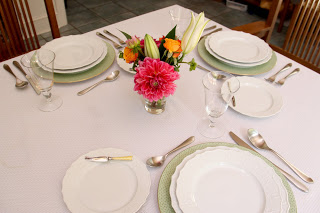 If you don't use a table cloth, in all cases, the table feels a little naked or tinny without a placemat. A placemat can be a square or rectangle, made of wicker, paper, fabric or cloth napkins opened up flat. In all cases, get rid of the wrinkles in fabric by ironing them. Wrinkles are distracting to the viewer (that is your guest). Just like you wouldn't go to a nice event with wrinkled clothing, similarly you want the table dressing to be clean and wrinkle-free.
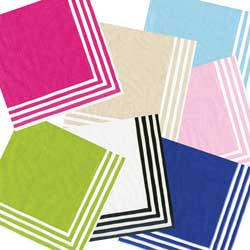
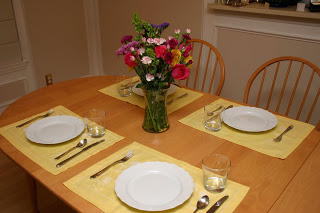 Napkins are a must at a table (and to be honest, I usually forget to add them until it's too late and my guest is weighing the options of licking their fingers or going throughout the meal with sauce on their face.) Cloth napkins are preferred in a formal setting, but there are many companies that make beautiful paper napkins. Paper has the benefit of going in the trash instead of the washing machine and it's easier to get creative with colors. If you are planning a chartreuse table with magenta flowers on the table, you can probably find paper napkins that achieve the look you have envisioned. One company we recommend, and use ourselves, is Capspari. They make colorful, high quality paper products at an affordable price.
 Now that we have the first layer of the table decided, let's move on to the porcelain. Check back next Friday for a Mottahedeh Memo regarding what plates go where.